Fantastic Philatelic Discovery, Exclusive Booklet of
North Korean Stamps from the Period before the Siege of Pyongyang

What a wonderful feeling to find something new, a philatelic treasure, a real “philagem”. And how wonderful to be able to add a stamp to your collection of which only 2 copies exist, or add both! A wonderful philatelic discovery, from a troubled era, from the philately of a closed country! The feeling when we first realized what we had in our hands was indescribable, a real “Wow!” moment!

The outside world knows very little about North Korea and North Korean philately, so when this album came out of a bequest, no one knew exactly what we had in our hands. Research over the following months answered many questions and proved that the album contains some fantastic philatelic novelties alongside several extremely rare stamps!

On this page we briefly describe the historical context, the probable historical background and present the stamps in the album one by one.

Historical background

The historical overview can be read on wikipedia, among others, so in the following we will only highlight the philatelically relevant parts.

As we all know, the purpose of stamp issues from the very beginning was to convey political and cultural messages. This was no different in the case of the newly formed North Korean People’s Republic. As the Eastern European countries had experienced after World War II, one occupation after another brings with it much misery, and this was no different in Korea when Russian troops arrived after the Japanese occupation forces.

The poverty of the period is also reflected in the poor quality of stamp issues, both in terms of paper, tooth and printing technology. The stamp issues were produced without gumming for the same reasons. The stamps were initially used to depict the national symbols, but gradually the achievements of the State were shown. Every year, the stamps issued to commemorate the anniversary of the liberation of Japan from oppression have a special place among the stamp issues, so the first sign of the cult of personality of Kim Il Sung was when he was depicted on the first anniversary stamp issue. The stamps also show that the period of peace brought prosperity, with the first two-colour stamps being issued, and even a three-colour stamp for the 4th anniversary of liberation.

Then, the outbreak of the Korean War changed everything, and after the initial quick successes of the North, a deadly fratricidal war developed. A more detailed history of the war can be read here.

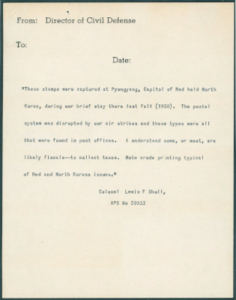
From a philatelic point of view, a key moment was the destruction of both the post office and the printing house during the southern counterattack in the autumn of 1950 during the siege of Pyongyang. This destroyed all of the printing equipment and most of the printed stamps. As a result, new printing equipment had to be built for the official reprint in 1957.

In the light of these events, it is easier to understand why early stamp issues are so rare. The vast majority of postal stamps, including some recently recovered from the estate of an “English gentleman”, were taken as “spoils of war” by the Southern soldiers.

Lot 110.

A telegram about the postal service descruction.

Story of the booklet

The story of the booklet cannot be separated from the historical facts, but many details are obscured. What we do know for sure is that the booklet was resting in a collection in Hungary in the last decades. Before that, there must not have been much “room for manoeuvre” for the booklet, given the laws that came into force in the second half of the 20th century, which kept stamp import-export within strict limits. We did some research on how the booklet got to Hungary, the starting point was that the last stamp in the booklet was issued on 4 April 1950, and during the Korean War nothing like this could have been produced, but after that new stamp issues appeared which are not included in the album, and reprints were issued in 1957, which are not included in the album either. This clearly places the production date of the booklet between April and October 1950. We have also been able to narrow this time interval further in view of the fact that a stamp issued for the 5th anniversary of Liberation was issued in June 1950, which would certainly have been included in such an exclusive issue, but is not included. It can therefore be said that the date of the album’s creation can be narrowed down to a two-month period: between April 1950 and June 1950. Considering that Kvon O Dik was inaugurated as Ambassador Extraordinary to Hungary in June 1950, it can be stated with almost absolute certainty that the booklet was brought to Hungary by Kvon O Dik as a gift to the President of the Presidential Council for his inauguration ceremonies.

We are convinced that the purpose of reissuing the stamps was
to celebrate the desired victory and to show the world a reunited Korea.

General details of the booklet

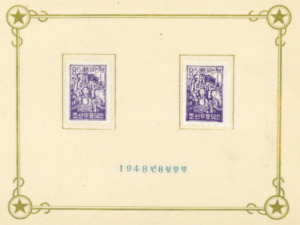
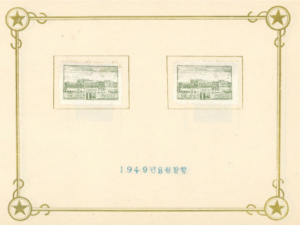
The booklet is bound in brown leatherette, with the North Korean coat of arms and stamp book inscription in gilt embossing. The booklet contains 24 stamps, two of a kind per page. Silk paper between the pages. The binding is worn, but the stamps and the inside pages are free of defects and stains. The upper part of the stamps is glued to the album pages.
The album dimension are: 21,5 x  16 cm

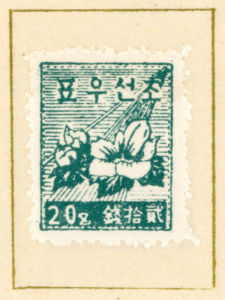
1946 Rose of Sharon

Two pieces with a slightly different design and colour from the first edition. The colour of the stamp is dark green. The above inscription has been transcribed in the style used since the second half of 1946 (the last letter of the inscription is different).
First edition: 조선
New issue: 죠션

This version of the stamp was previously unknown.

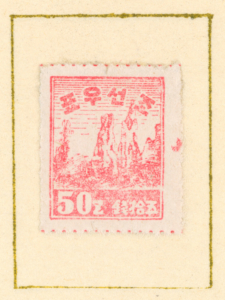
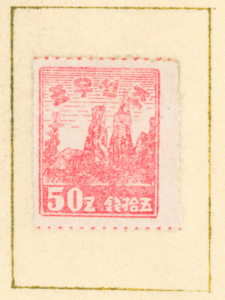
1946 Diamond Mountains

Two of the first edition stamps in a good quality – the 2nd edition with the denomination of 3 mm in height in rose color. The colour is rose carmin, which is a rare colour to see on the 2nd edition stamps.

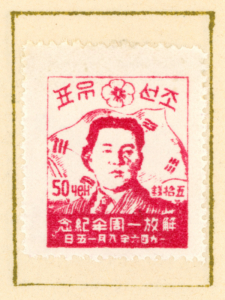
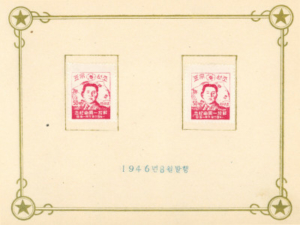
1946 The 1st Anniversary of Liberation from Japan

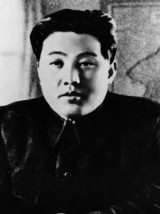
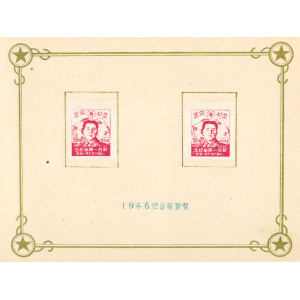
The Kim Il Sung red stamp has been a real mystery, everyone knows that there are a few copies, listed in various catalogues, but why they exist – we didn’t know until now. The way to the answer was through photographic archives. If you look at Kim’s official portrait from 1946, you can clearly see that the image on the brown stamp was taken from this photograph.

1946

1950

Over time, however, Kim changed, and by 1950 he no longer resembled either the official photograph or the portrait on the stamp. It is almost certain that this is why it was decided to reissue the stamp with an ‘updated’ portrait.

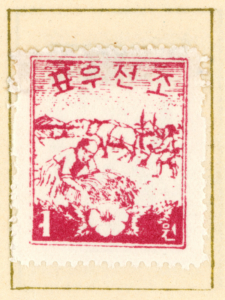
1947 The 1st Anniversary of the Agrarian Reform

The red colour variant of the stamps already known, but the design of the stamp has also been changed. Obviously printed from a new plate, the image of the stamp and the text are much nicer – clearer.  The woman who picks the sheaves of wheat has a face, the image has been given a background and a number of small corrections can be seen in the design of the stamp.

This version of the stamp was previously unknown.

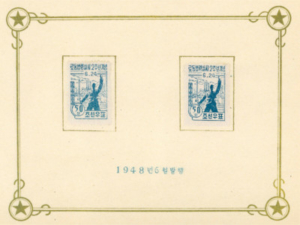
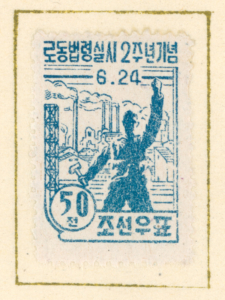
1948 The 2nd Anniversary of the Labour Law

First edition stamps in nice quality impressions, in two known colour shades – blue and light blue.

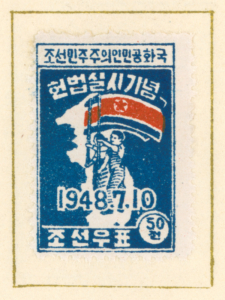
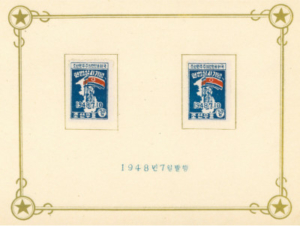
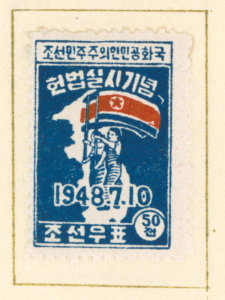
1948 Adoption of the Constitution

First edition stamps in nice quality impressions.

In contrast to the Scott catalog, which lists the Constitution stamp before the Liberation 3rd Anniversary stamp by issue date, the stamp booklet lists the Liberation stamp first and the Constitution stamp second. This arrangement is consistent with the official North Korean narrative, since the celebration was on July 10, so they list the stamp before the Constitution issue. Therefore the order in the booklet corresponds to the order in the official DPKR catalogue.

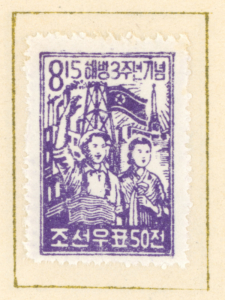
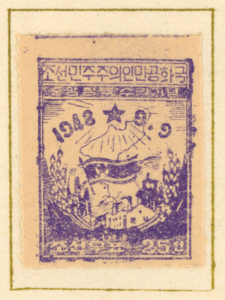
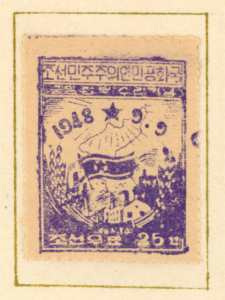
1948 The 3rd Anniversary of the Liberation from Japan

A slightly different design to the first edition, the colour is the familiar purple, but the image of the stamp and the text are much prettier and clearer. The male figure on the first edition stamp looks more like an intellectual in a tie than a worker. This may be the reason why he has been “re-dressed” and is now shown in the new design in a worker’s outfit. The female figure is much thinner and her clothing is more reminiscent of traditional dress.

This version of the stamp was previously unknown.

1948 Etablishment of the People’s Republic

First edition stamps in nice quality impressions.

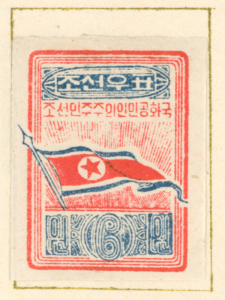
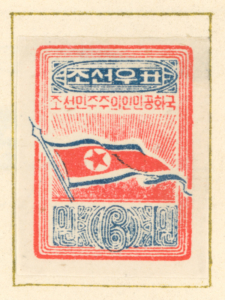
1949 North Korean Flag

First edition stamps in nice quality impressions.

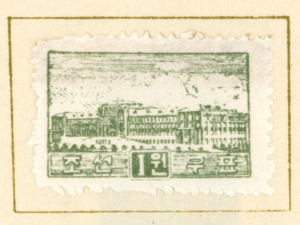
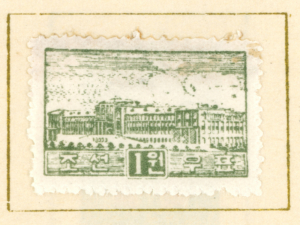
1949 Opening of Kim II Sung University in Pyongyang

The first edition stamps, but in a new color variant – oil green.

This color variant of the stamp was previously unknown.

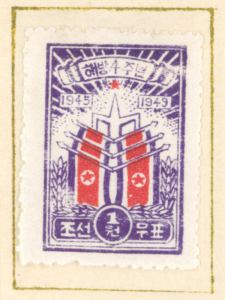
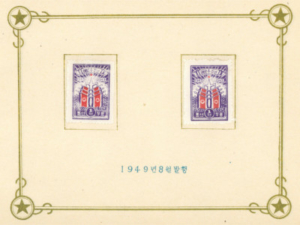
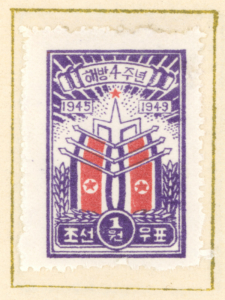
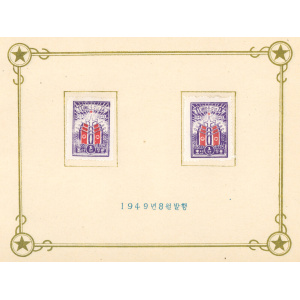
1949 The 4th Anniversary of Liberation from Japan

The stamp issued for the 4th anniversary of Liberation was completely redesigned, as was the red Kim Il Sung stamp. There is no doubt about the reason for the redesign, the 4th anniversary stamp was indeed not very well done, especially the green tinted wreath, which in all cases was a blurred blob. It can be seen that they have gone back to the two-colour printing and the wreath has been drawn with the purple ground colour.

This version of the stamp was previously unknown.

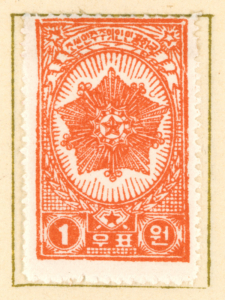
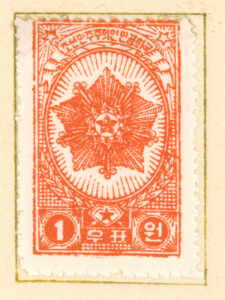
Order of the National Flag

The last pair of stamps in the album, and the only one without the date and stamp name preprinted at the bottom. This also proves as described above that the extraordinary consignor brought the album with him, as these stamps were only issued in the days before the departure. The stamps are identical to the known issue, the colour being the rare dark orange variant.

The estimated value of the extraordinary stamps presented above is of course a benchmark, because who can estimate the value of a red Kim Il Sung stamp that has not been on the market for decades, or how much a 74-year-old stamp that is still unknown is worth….
The booklet’s starting price starts at the 70% of the lower end of the estimated value, and we are excited to see how much this sensational discovery will find a new owner.